
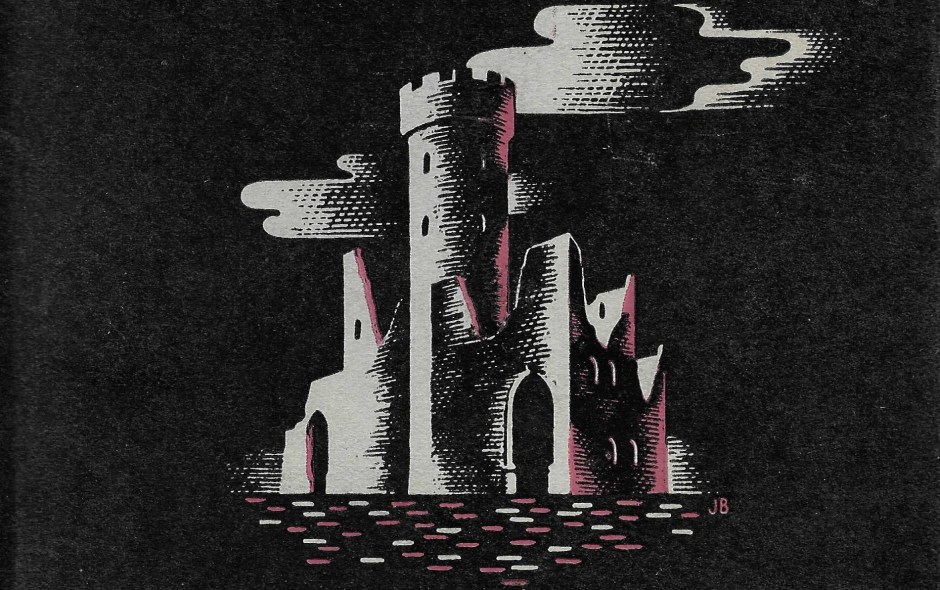
In the late 1730s Mark Amberley, of the Cottington Place estate in Southshire, England, built a sham castle on his estate. He also built a shell-encrusted grotto, which became home to the obligatory bearded hermit dressed in brown hessian robes. The creation of these follies is detailed in the family archive of letters and diaries, which was explored by a descendant in the twentieth century.

The book looks afresh at the murder of Mark Amberley, who was shot in the head on the very day that he returned to Cottington in 1768, after spending twenty three years in exile after the Jacobite Rebellion. The dust jacket gives a precis of the plot and notes that the story was based on unpublished material. But if one reads on to the end the truth is revealed: ‘Mr Bamford’s novel is, of course, pure fiction as are the statements in the above paragraphs’. The Flâneuse is always delighted to discover fictional follies, and the Amberleys, the murder, the sham castle and grotto are all the creation of Frances Bamford, and appear in his 1946 novel Return to Cottington.
Francis Bamford who was born on the Isle of Wight in 1905, the son of a clergyman. In his twenties he mixed with the Bright Young Things and became close friends with the Sitwell family of Renishaw and Weston. The patriarch of the family was Sir George Sitwell, and when his wife died in 1937 it was feared that Sir George’s eccentricities would no longer be checked by his spouse. Osbert Sitwell asked Bamford, who was then unmarried and in need of funds, to be secretary to his father and to accompany Sir George to his Tuscan castle of Montegufoni. When Bamford asked what the duties were, Osbert’s casual reply was, ‘Well, you must just take Mother’s place.’

In 1939 Bamford described himself as ‘Archivist, Historian and Author’, and by that date he had already published the correspondence of a Georgian lady as well as a history of Edinburgh written with Sacheverell Sitwell and a novel. With the outbreak of war, Bamford joined the Gordon Highlanders (his mother was descended from the Duke of Gordon). As the war progressed, Bamford found himself stationed at Stromness on Orkney. There he used his spare time to write his second novel, Return to Cottington, which was published in 1946 and dedicated to his friend Sir Osbert Sitwell (Sitwell’s signed copy is in the library at Renishaw, his Derbyshire seat).

Readers may wish to read the story for themselves, so we will leave the plot and consider the follies built by our protagonist, Mark Amberley. On the edge of the park at Cottington was a small hill, and upon its ‘flattened crest’ Amberley built ‘an improbable ruin consisting of twelve open arches flanked by two incomplete towers’. Work began soon after he inherited the estate in 1738, and was complete by 1742. As well as improving the view from the dining room, the family visited the folly for ‘pick-nicks’.
With the sham castle complete, Amberley began work on his ‘curious Gothick grotto’. This was a natural cave, in a disused quarry, which was extended to create two rooms – the first highly-decorated with shells and stone seats ‘carved to represent oyster-shells supported upon dolphins’. This led to a second chamber with a fireplace with its chimney ‘carried up through the solid rock’. From the grotto there were superb views to the mansion designed by Sir Christopher Wren. Peter the Hermit took up residence as soon as work was complete.
Perhaps the interior of the Cottington grotto was a little like that at Oatlands in Surrey, although that example was not built until two decades later.

In the late 1730s sham ruined castles were yet to appear in British parks, so if he had only been real Mark Amberley would have been at the forefront of folly building. We don’t know which genuine shams may have inspired Bamford, but perhaps he knew Hagley in Worcestershire…

… or Wimpole in Cambridgeshire.

After the war Bamford was employed as librarian to the Duke of Wellington: in 1950 they jointly published The Journal of Mrs Arbuthnot, based on papers in the Duke’s archive (genuine documents this time). By that date Bamford and his wife Marianne had moved to Ayton, near Berwick upon Tweed, to open an antique shop although Bamford also continued to write. He became known as an expert on Scottish furniture, but his sudden death in 1982 meant that his research was published posthumously a year later. Bamford may also have been camera-shy, as the Flâneuse has failed to find a single photograph of him.
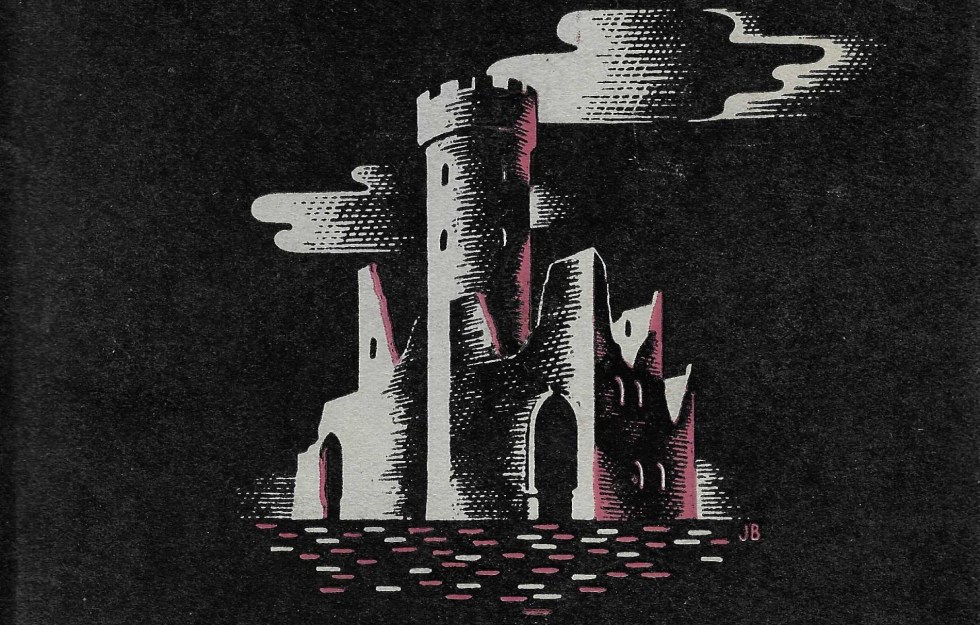
According to the story, the sham castle was still standing when Return to Cottington was published in 1946, although by then it loomed over modern housing built in Cottington’s park. The impoverished Amberleys had sold the estate to the County Council, and the mansion was in use as a maternity home for working class mothers. The grotto was intact, but the walls were carved with the names of young men and women ‘seeking for one reason or another its sombre solitude’. Should she ever find herself in Southshire the Flâneuse will endeavour to discover if any fragments survive today.
Meanwhile…

Researching this post was great fun so the Flâneuse will be raising her glass to a group of friends – Guy Marshall for alerting me to the book; antiquarian booksellers Adam and Marianne Naylor for rapidly posting a copy to the eager Flâneuse; Chris Beevers, Archivist at Renishaw Hall, for help with the Sitwells and Mike Cousins (aka the Garden Historian) for helping with a chronology of sham castles and grottoes.
And thank you for reading. As ever, you can share your thoughts via the comments box at the foot of the page.


paul thomas says:
Thanks for your amazing research.
Your posts are a lovely way to start every weekend.
Kind regards
Paul
Editor says:
Thank you Paul. I am really grateful for your kind words.
Helene Gammack says:
Wonderful, sounds right up my street.
Editor says:
Good morning Helene. It’s a good read if you can find a copy. Bamford weaves his expert knowledge of the 18C into a murder mystery.
Gwyn Headley says:
How wonderful! Completely new to me.
Editor says:
Good morning Gwyn. It was new to me too, and I’m grateful to my friend Guy for introducing me to it. Great fun.
Suzannah Fleming says:
Excellent piece!!!! I approve of the idea of literary garden and architectural history in novels!!
Editor says:
Hello Suzannah. The novel is crafted so well, with Bamford sneaking his brilliant knowledge of the period into the plot. Pleased you enjoyed it!
TOM GARDNER says:
TOM – NYC
SIMPLY AMAZING, JUST HOW MANY ‘LOCATIONS’ THERE ARE – TO BE FOUND IN YOUR ‘HOMELAND’.
AS MENTIONED, NOW BEING 80, IN MY YOUTH (1966-1976) I WAS IN THE ‘AMERICAN VERSION – OF THE DOMESTIC FIELD (HOUSEHOLD STAFF). AS BUTLER TO THE LAST: ‘ASTOR – 400’ – I WAS LUCKY ENOUGH TO EXPERIENCE ‘RESIDENCES’ OF IMPRESSIVE DESIGN. PERHAPS THAT’S WHY I UNDERSTAND YOUR OFFERINGS, GRACED WITH AN ADDED INSIGHT AS TO THEIR BEAUTY AND CONSTRUCTION.
BRAVO AND KEEP UP THE WONDERFUL OFFERINGS.
TOM
Editor says:
Good evening Tom and thanks for sharing your appreciation.
Nigel Searle says:
Thank you for yet another fascinating read. I couldn’t help wondering whether Mark Amberley’s follies of Bamford’s in ‘Return to Cottington’ might also have been influenced/inspired in some way by Cook’s Castle and obelisk at Appuldurcombe on the Isle of Wight (as previously discussed https://thefollyflaneuse.com/cooks-castle-and-the-obelisk-appuldurcombe-isle-of-wight/ ) which, although becoming ruinous by then, might have had a similar appearance to that depicted on the book’s cover and, being nearby to their home (nowhere on the IoW is that that far away from any other location there) is likely to have visited by the young Francis & his family. Assuming that the Rev. Francis Bamford, given as being vicar of All Saints’ Church, Newchurch on the island between 1896 and 1934 (see this blog https://louisemabey.com/tag/reverend-francis-bamford ) was Francis’s father – there appear to be too many coincidences (ie shared Christian name, island location, dates etc) for him not to have been – there are likely to have been plenty of opportunities for him to have explored the area as a child or teenager. The blog includes a photograph of Newchurch’s ‘Pageant of St George’ in 1914 which shows Rev. Francis Bamford (were vicars exempt from dressing up or taking part in such activities in order to maintain their dignity, I wonder…) It’s possible to imagine, but unlikely to be confirmable, that the boy third from the right, sporting a St George’s Cross adorned tabard and faux chain mail coif, might just be Francis junior who would have been nine or ten at that time and unlikely to have been able to avoid taking part (he certainly doesn’t look too happy about it.)
I should add, having come across the overgrown stone marking its site, that I first chanced on your great resource while looking for details of Cook’s Castle; I’ve been hooked ever since.
Best Wishes
Nigel
Editor says:
Good morning Chris. Thanks for these really useful observations. I did wonder about Cook’s Castle as a possible influence, and I should have mentioned it. Bamford certainly knew the scandalous story of Sir Richard and Lady Worsley of Appuldurcombe and the bath house, as he includes a fictionalised mention in the novel.
I did find the blog you mention, as did Chris Beevers of Renishaw, and we felt sure Francis must be one of the boys (the photo is of his father as your surmised). But a photo of him later in life remains elusive. One of the comments on that blog was from Bamford’s son, but I couldn’t see a way to get in touch.
Thanks for your kind comments, and I am very pleased you discovered my weekly posts.
Chris Beevers says:
Brilliant article – piecing together fragments of information to make a fascinating read – and setting a challenge to find an image of the elusive Mr Bamford! Many thanks
Editor says:
Thanks Chris. And thanks again for your help.
Iain KS Gray says:
This one-off tale and the murder it mentioned brought to mind the recent murder of Putney resident and FF member Mark Talbot for which his son has been charged. Mark owned the renowned triangular Sussex folly -The “Racton Ruin”. I can’t help wondering who has inherited it.
Editor says:
Good morning Iain. This was a most distressing incident, and I suspect the legal issues will take some time to resolve. My thoughts remain with the family.
Tim Harley says:
By coincidence , the same evening that I read this piece I read a whodunnit short story , Sergeant Pollock in Parliament by William Fienburgh. In it there is a character Mr Bulrose , Member of Parliament for Southshire. He is PPS to the Minister of Planning and Reconstruction . the story is contained in the British Library publication Metropolitan Mysteries edited by Martin Edwards.
Editor says:
Good afternoon Tim. Two strange coincidences – that two authors should choose the same name for a fictional county, and that you should encounter both on the same day. Thanks for letting me know, and I will look out for Metropolitan Mysteries.