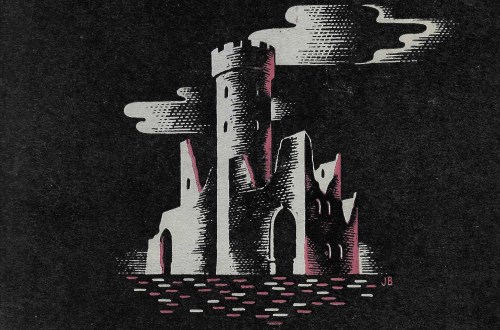

In the grounds of Loxley Hall, near Uttoxeter in Staffordshire, there once stood a very curious structure known as ‘the Grotto’ or ‘Robin Hood’s Chapel’. It incorporated fragments which had been salvaged from the mansion when it was ‘partially rebuilt’ early in the eighteenth century. According to legend, Loxley Hall was the birthplace of Robin Hood, or alternatively the spot where he wooed Maid Marian, and hence the romantic name given to this decidedly quirky garden building (this detail is from the only known view of the folly, read on to see a little more).
Loxley was the ancient seat of the Ferrers and descended via the Kynnersleys until 1815 when Thomas Sneyd took the name Sneyd-Kynnersley as a condition of inheriting the estate. The association with ‘Robin Hood of Loxley’ is hotly contested, with Loxley near Sheffield and Locksley in Nottinghamshire also claiming to be the birthplace of the famous outlaw. What was said to be Robin Hood’s hunting horn could be seen in Loxley Hall in living history but, like the grotto, it has since vanished without trace.

Stebbing Shaw (1762-1802) called the mansion at Loxley ‘curious’ in the first volume of his 1798 history of Staffordshire. Sadly, he didn’t live to complete the planned subsequent volumes where he had intended to write at length about Loxley Park. He did however produce an engraving of the house, then the seat of Clement Kynnersley (1744-1815)
Thomas Sneyd-Kynnersley (1774-1844) seems to have lived at Loxley during his Uncle Clement’s lifetime, but took full possession upon his death in 1815. Soon after that date Sneyd-Kynnersley began work on updating the mansion. Burke’s A Visitation of the Seats and Arms of the Noblemen and Gentlemen of Great Britain of 1852 suggests the work was undertaken around 1817, and it was complete by 1821 when this view was engraved.

According to Burke, Sneyd-Kynnersley also made a number of improvements to the estate following his uncle’s death. This included planting, draining and improving the farmhouses and cottages.

An exact date for the construction of the folly is not known, but it is likely to date from this same period of activity. It was certainly extant before Sneyd-Kynnersley’s death in 1844, as it appears on the tithe map of 1843. The folly is shown in a long and narrow shrubbery, cut through with a ride called the Long Walk. It no doubt served as an eye-catcher along the route, and a place to stop for shelter and refreshments. How and when it acquired the name of ‘Robin Hood’s Chapel’ (some locals know the Long Walk as Maid Marian’s Way) is not clear. It seems to be an oral tradition as the building is not named on the tithe or Ordnance Survey maps, and the few references to it in print refer to it as ‘the grotto’.
The fragments are an eclectic mix: Corinthian capitals, garlands of flowers and heraldic shields – the seated greyhound of the Kynnersleys and the lion rampant of the Sneyds. The Stebbing Shaw view of the old house seems to show pilasters to either side of the door to the house, which might be the source of the capitals, and presumably some of the decoration from the tympanum was reused. The original location of the grotesque keystone remains a mystery. This grainy photograph, taken from a postcard, is the only view of the grotto that can be found.

The best description of ‘the grotto’ comes from an account of a lively fête champêtre held in the grounds of Loxley Park in 1859, when the Uttoxeter Literary and Scientific Society had a grand day out. Their report tells that the windows of the grotto were glazed with small, square panes of glass carrying emblems of the Ferrers, also rescued from the old house (a writer a few years later noted that only one piece survived intact). An elaborately carved oak door, once at the entrance to the old mansion, formed the way in to the grotto.
Once inside, visitors would have found themselves standing on a floor made of the teeth and bones of animals whilst admiring walls ‘encrusted with thousands of shells, and a variety of minerals in cement disposed in various devices’. On the back wall, the shells were arranged to look like a ‘mullioned Gothic window.’
The hall was requisitioned during the Second World War and in the years immediately after the hostilities ended it housed a European Voluntary Worker’s Hostel. In 1954 it was purchased by the local council for use as a school, and today is home to an educational trust which provides for boys with social, emotional and mental health needs (SEMH).
The folly was not mentioned in the 1974 Staffordshire volume of the ‘Buildings of England’ series by Nikolaus Pevsner, but it must have been standing at that point as the structure was added to the National Heritage List for England in 1985 (grade II). It was named as the ‘Garden House’, and the report noted it was roofless at that date. In 1998 local historian Jim Foley wrote that he was saddened to see the building ‘crumbling away soon be lost to posterity for ever’ and by 2013 it was gone.

The stones of the grade II listed structure were apparently taken into storage for safekeeping (the Flâneuse is assuming that schoolboys and a mysterious derelict structure were not thought to be a good mix). However, despite appeals to various offices within the local and county councils, discovering the current whereabouts of the carved fragments seems to be as impossible as proving the identity of Robin Hood.
Thank you for reading. If you can solve the Mystery of the Missing Masonry please get in touch. General comments are also very welcome via the box at the foot of the page
‘