
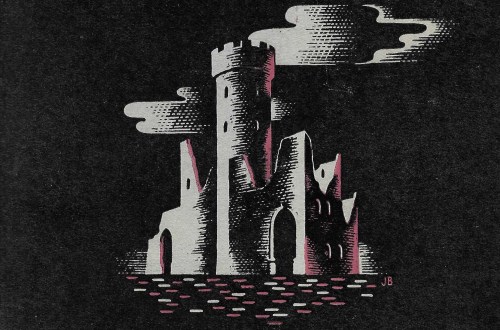
On the wooded slopes overlooking the west bank of Windermere in Cumbria (formerly Lancashire) stand the truncated remains of Sowler’s Tower. Although no great beauty today, this curious structure has an absolutely fascinating history. According to one source it was the last resting place of its builders, the Sowlers of Sawrey Knotts, with Mrs Sowler apparently spending eternity within the tower in a glass-topped coffin. The tower is indeed a mausoleum, but its residents are not the Sowlers.
Robert Scarr Sowler (1815-1871) was the son of the editor and proprietor of the Manchester Courier, a role he later inherited. He also had a career in law as a Queen’s Counsel and was active in politics in the ‘Conservative Cause’. Like many other Manchester businessmen he decided upon a house in the Lake District where he could pass ‘such leisure time as he had at command’.

In 1861 he purchased some parcels of land on Sawrey Knotts, advertised as ‘very eligible building sites’ on land ‘tastefully interspersed with Ornamental Trees’. He had a new home built which he named after the location, Sawrey Knotts. The architect was Miles Thompson (1808-1868), who had trained with the well-known Websters of Kendal, and the house was described as ‘just about being completed’ in 1863 (although the datestone gives the year 1866). Immediately behind the house a tower was erected to take advantage of the view.
Business often took Sowler away, but with his wife Frances (1813-1879) he spent part of the year at Sawrey Knotts, enjoying the lakeland scenery. On the piece of land called Sawrey Knotts Brow, the highest spot on his estate, the Sowlers built another belvedere with an even greater panorama of Windermere and the surrounding hills. A stone plaque on the higher tower, named as ‘Sowler’s Tower’ on O.S. maps, confirms the date of 1865.

As well as being a spot for admiring the view and picnicking, the tower was probably also a landmark for the hunt. In 1867 the local paper noted that ‘Reynard’ had ‘swept over Sawrey Knotts past the Giant’s tower’: to date this is the only reference found calling it by this name. In that same year, the Union Jack was flown from the ‘lower tower’ to mark the first roof timber being fitted into place at the new village church, and flags were flown from both towers on high days and holidays. Sadly, readers will have to use their imagination, for no early views of the tower can be found.
The architect of the tower is not known, but was most likely Thompson, who was working on the main house. The story is told locally that Sowler liked to look across the lake to the landmark when he arrived back at Windermere station after business had taken him away (the station hotel was designed by Thompson and may have influenced his choice of architect).

In 1978 architect and follyphiliac Neville Hawkes was taken to see the exterior of the tower by Captain Cedric Dand, of the Sawrey Knotts Hotel and Trekking Centre, as Sowler’s former home had become by 1970. Frustratingly, the Lake District’s notoriously unsettled weather meant that he didn’t take any photographs. Hawkes was told that in the tower there was a structure which housed the coffins of the Sowlers – Robert and his ‘wife Frances who predeceased him and her coffin was glass topped’.
It’s a great story, but one that doesn’t add up. Robert Sowler died first, in 1871, and was buried in St Saviour’s in Ringley, Manchester. Frances was also buried there in 1879. Frances commissioned a memorial window in her husband’s memory which was installed in St Peter’s, Sawrey in 1873 (Sowler had instigated the erection of the church in the mid-1860s). A second window commemorates Frances, and was erected by her sisters.
Captain Dand is remembered as a ‘character’: the ex-Cavalry officer made the news in 1966 when he and a Mrs Elizabeth Braithwaite (‘a businessman’s wife’) claimed to be the first to have trekked to the top of Scafell Pike on horseback. Was Dand pulling Hawkes leg with the tale that the Sowlers were buried in the tower, or did Hawkes misremember the story? Happily, there is a more accurate history of the tower: the building did indeed become a mausoleum, but not for the Sowlers and not until more than a century after the tower was first built in 1865.
Sarah Hilda Edmondson (1892-1963), whose father Robert Holt Edmondson was a major landowner in Sawrey, married Victor Whitaker (1887-1971) in 1923. The couple lived at Howe End in Far Sawrey (their neighbour Beatrix Potter presented Sarah with a copy of the newly-published Tale of Little Pig Robinson at Christmas 1930).

In 1940 the Sawrey Knotts estate was offered for sale, with the ‘well known Sowlers Tower’ and some grazing land being made available separately, and it would seem that the Whitakers bought the tower and land at that date. In 1956 plans were drawn up for what was euphemistically described as a ‘store’ at Sowler’s Tower. The plan shows that Sowler’s Tower was to be lowered to around 10 feet (3m) in height and left roofless: within this fortress of a shell the mausoleum was to be erected. According to the plan it was to be an eight foot (2.5m) square building with walls a whopping two feet (60cm) thick under a Westmorland slate roof.

When Sarah Whitaker died in February 1963, her will requested that her funeral should be carried out and her body ‘disposed of’ in accordance with her wishes, which had been communicated to her Trustees. No further information is attached to the will, but we know that Sarah was interred in the tower as Victor Whitaker’s will included the instruction that he was to be buried alongside his wife ‘in the Vault at Sawrey Knotts’. It also stipulated that his executors should ‘make provision for the upkeep of my grave and my wife’s grave’.

In a memorandum that accompanied his will, he also requested that a stone should be inserted at the vault to match ‘the existing one of Judge Sowler’s’. The simple stone was to carry the initials of he and his wife together with the dates of their death, and his notes include a sketch of how he wished it to look. He also asked that there be a ‘metal plate on outer door suitably inscribed’.
In 1978 Neville Hawkes was told that the vault was ‘in the corner’, so if the tomb designed in 1956 was erected, it must have been removed by that date. After Victor’s death in 1971 the door to the tower was blocked, and barbed wire and jagged glass was put up along the roofline, allowing no access to the interior. All we can be sure of is that Sowler’s Tower was lowered to become the strange, squat structure we see today (slate from the upper storeys scatters the hillside around the tower), and there are no memorial plaques to the Whitakers on the exterior of the building.
The family of the present owners of Sowler’s Tower added it, and the surrounding land, to their estate in 1984. The sale contract stipulated that the coffins were to ‘remain in their present positions without interference whatsoever’ in perpetuity. The Whitakers continue to requiescat in pace in their unusual mausoleum in this tranquil spot.
Sawrey Knotts and its outbuildings, including the belvedere behind the house, have been converted into a number of holiday homes and can be seen from a public footpath. There is no public access to the remains of Sowler’s Tower.
The Flâneuse is very grateful to the present owners of the tower for their help with this post.
Thank you for reading. Your thoughts can be shared by scrolling down to the comments box at the foot of the page.



TOM GARDNER says:
TOM (NYC)
WOW! QUITE A HISTORY!
AS FOR MYSELF, A SIMPLE URN WILL BE MY FINAL (EARTHLY) ADDRESS.
YOUR INITIAL PHOTO OF THE HOUSE, PROVED MOST INTERESTING.
AS I, ALONG WITH MY SPOUSE, SHELDON (BARR) OF 50 YEARS, NOW FACE
THE TASK OF ‘ORGANISING’ SUCH DETAILS OF THIS NEXT … ‘JOURNEY.’
IN CLOSING, REMEMBER: ‘NO ONE GETS OUT OF THIS LIFE … ALIVE’
Editor says:
Hello Tom. I think it’s wonderful that a tower, built so that a family could enjoy picnics and prospects, could later become the last resting place of a couple who also loved that spot.
Rita Lamb says:
Reading the name “Sawrey Knotts Brow” reminded me that my mother, a Lancashire woman, always pronounced “brow” as “broo” when using it to refer to a geographical feature. (I mean, as in a small hill or slope. She didn’t say “eyebroo”.)
Editor says:
Hello Rita. Regional accents are endlessly fascinating – thanks for sharing this memory and I will think of it as Sawrey Knotts Broo now!