

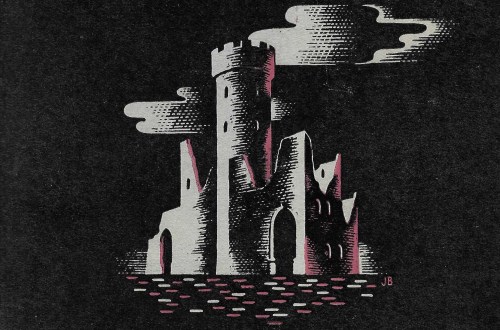
Late in the eighteenth century, the Grant family lost their livelihood in their native Scotland and set out to find work in the rapidly developing industries of Lancashire. Pausing to rest on their journey they admired the ‘beautiful valley’ of the River Irwell, which reminded them of Speyside. Decades later they bought the ground, and erected this tower to commemorate that moment.

William Grant (1769-1842) recounted this history in a letter of 1839. He told how he found work in Bury, historically Lancashire but now Greater Manchester, and with his brothers became ‘very successful’ in the textile business (the ‘rags to riches’ story of the brothers is said to have inspired the characters the Cheeryble brothers in Nicholas Nickleby by Charles Dickens). In 1827 the family added the Park Estate to their considerable land holdings, and there, as Grant wrote, they erected a ‘monument to commemorate my father’s first visit to the valley’. Almost immediately the building became known as ‘Grant’s Tower’.

The architect is not known, and few early descriptions of the tower can be found, but we can assume that the Grants used the tower as a belvedere and party venue. There were wedding festivities at John Grant’s Nuttall Hall in 1848 and banners were hoisted on Grant’s Tower, high above the house (Nuttall Hall was demolished in 1952 and the grounds are now a public park).

The public were initially invited to visit on set days, but by 1892 it was open daily and a popular destination for picnic parties. Refreshments were available, and no doubt picture postcards were also sold – many different views of the tower were in circulation.

In the early years of the twentieth century the tower could be discovered in many kitchens as it featured on the label of a ‘delicious relish’ called Tower Sauce. Manufactured by Scott & Rosse of Bury, this condiment could, if one believed the advertisements, aid digestion, produce an appetite and ‘please every palate’.

It is first mentioned in newspaper ads in 1904, and the marketing department hit their stride in 1905 when a housewife could send the company three one penny stamps and in return receive a free sample of the sauce and six picture postcards. The cards were ‘guaranteed to be free from advertisements’ – were they perhaps views of the tower?
By 1911 the tower was ‘showing signs of neglect’ and in 1914 the interior of the tower was said to be in a ‘ruinous condition’. There were plans to repair the ‘famous Lancashire landmark’, but the outbreak of the First World War meant that plans were shelved.

Around 1940, with another war underway, Ramsbottom Urban Council began negotiations with the tower’s owner, Sir Peter Lawson, to take control of the tower as soon as the hostilities were over. No agreement was reached, and soon after the tower was closed to the public as unsafe. In September 1944, when ‘Ramsbottom’s weather beaten landmark’ collapsed, the local paper reported that this ‘did not come as a big surprise’. The more dangerous walls of the truncated tower were demolished, and only the roofless lower storey was left standing.

In 2017 Bury Council granted the owner of the tower (it had by now changed hands) permission to repair and reroof the remains of the tower to prevent any further damage to the interior. The renovated remains can be seen from the public footpath that passes the tower.

The Flâneuse would be delighted to hear from you – the comments box is at the bottom of the page if you would like to share any thoughts. If you would like a complimentary folly story in your inbox each week please see below. Thank you for reading.


Gand says:
A Lancashire Folly on Yorkshire day. Shame on you.
Another great read all the same
Editor says:
Oh dear! I promise it wasn’t deliberate and apologies to all Yorkshire folk. As a Northumbrian by birth I am entirely neutral in the war of the roses!
Tony Cleaver says:
I love reading your articles about follies, don’t know how you manage to research them all. Best wishes
Editor says:
Thanks Tony. I really enjoy the research and kind comments like this make it all seem worthwhile.
TOM GARDNER says:
TOM – HERE,
HOW TRULY … SAD!
SUCH A WONDERFUL ‘STRUCTURE’ –
LEFT – TO: RACK & RUIN.
* THANK GOODNESS FOR THE PHOTOS.
Editor says:
Good morning Tom. It is always sad to write about lost follies (or almost lost in this case), but it is some consolation to have a good visual record.