

Blagdon Hall stands close to the former Great North Road, a few miles north of Newcastle upon Tyne. At the end of the lake stands a circle of Doric columns known as The Temple. The columns were first erected as part of a rotunda ,with an unusual domed roof, at Heaton Hall, on the edge of Newcastle. Part of the grounds of Heaton Hall later became a public park, but when it looked as if the Temple was going to be a drain on corporation funds, it was removed to Blagdon in around 1937.

Matthew Ridley (1711-1778) of Heaton Hall was a successful businessman and represented Newcastle as mayor and as Member of Parliament. He succeeded his father to Heaton Hall in 1739, by which date the ‘beautiful house’ already stood amongst avenues, gardens and a wilderness. Ridley added a new stone front to the existing brick mansion, with towers at the corners and by 1766 Heaton Hall was noted by Sir Roger Newdigate as a ‘well looking house with round Towers at each End sashd & modern’ (confirming that the house was remodelled by Matthew Ridley, and not by his son Sir Matthew White Ridley in the 1770s as has previously been stated). An account in 1787 confirms that the architect of the new front was William Newton of Newcastle.
Ridley must also have been laying out his grounds in the then fashionable natural style: the park was described in 1769 as planted with ‘small clumps of young forest-trees’ (there is a tantalising mention of the landscape designer Richard Woods leaving Harewood in Yorkshire to visit ‘Mr Ridley’ in Northumberland in 1765). The watercolour below shows that there was a vista through a plantation to the Temple as a distant eye-catcher when approaching the estate.

The Temple probably also dates from this period of improvements. It is described as a ‘tempiato’ in Wallis’s The Natural History and Antiquities of Northumberland… of 1769, and in the 1770s William Beilby painted it for the Duchess of Northumberland’s album of views. It may also be the work of William Newton, although no evidence is known to survive.

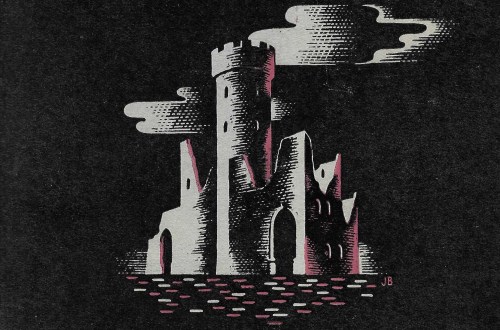
Sadly no trace survives of some ‘mock ruins’ built by Ridley ‘as ornamental objects from Heaton Hall’. This folly, also extant by 1769, stood on an eminence at nearby Byker and as well as being an object from Heaton Hall, it gave a ‘most extensive prospect’ of the town of Newcastle and the shipping on the Tyne.

The Ridleys left Heaton in the middle of the nineteenth century, and the estate became home to the Potter family. In 1878 Addison Potter sold part of the pleasure grounds to the Corporation of Newcastle for use as a public park – this portion included the ‘ornamental temple-like building’, which was one of the first things to be seen when entering the new park via the South Gate. The Gardeners’ Chronicle magazine liked how the corporation had conserved the pleasure garden ‘very much as it was as a residential place’. Picture postcards show the Temple at the top of a slope, with steps rising through a rockery, although it is not clear if this was created by the Potter family or if it is a later landscaping by the Parks department.

In 1932 the Potters sold Heaton Hall, and the remainder of its ground, to a firm of builders. Under the headline ‘The End of Heaton Hall’ the local paper announced that the hall would be razed and the land developed for housing.
Meanwhile, the Temple in the park was not being kept in good repair and in December 1936 a corporation working group discussed its future. The councillors were divided, with some wishing to see its immediate demolition and others keen that it should be repaired. By that date Viscount Ridley of Blagdon (the viscountcy was created in 1900) had already been consulted, and had agreed to take the columns if the Temple was to be pulled down. The vote was won 4:3 in favour of keeping the Temple, but by autumn 1937 no action had been taken and it was roped off from the public and declared unsafe. Contractors were called in to give estimates for taking the structure down and re-erecting it at Blagdon – a deal must have been struck and the columns were moved the few miles to Blagdon. History does not seem to record what happened to the domed roof, but the columns form a charming eye-catcher at the head of the lake.

Blagdon Hall is a private home but the gardens open for charity on a few days each year. You can find forthcoming dates here.

Heaton Park, with adjoining parks along the valley of the Ouse Burn, is a Grade II registered public park and is freely accessible.
The Flâneuse is grateful to Dr Michael Cousins for sharing his transcript of the travel diary of Sir Roger Newdigate. Thanks also to Fiona Green for sharing her research into Heaton Park and to Richard Pears for information on Blagdon Hall.
Thank you for reading. As ever your thoughts or observations are very welcome. The comments box can be found at the foot of the page.



TOM GARDNER says:
TOM (NYC)
TODAY IS THE 4th OF JULY! I’LL SAY NO MORE.
HOWEVER, DUE TO OUR OWN – REAL LIFE: ‘THE GILDED AGE’ –
WE HAVE NUMEROUS ‘COUNTRY’ HOMES OF OUR OWN.
THE MAJORITY OF THEM ARE FOUND ON THE EAST COAST OF THE USA –
SPECIFICALLY: NEWPORT, RHODE ISLAND, AND ON THE NORTH SHORE OF:
LONG ISLAND, NEW YORK.
HAVING BEEN A BUTLER MYSELF, FOR SEVERAL OF THEM, I HAVE A
SPECIAL ‘ATTACHMENT’ TO SEEING THEM SURVIVE & BE – REBORN.
IT DOES US ALL WELL, TO APPRECIATE WHAT HAS COME BEFORE.
ENOUGH.
TOM
Editor says:
Hello Tom. Belated birthday greetings to the USA.