
Nestled in woodland above a bend in the river Tweed stands what is today known as the Gledswood estate. Close to the West, or Eagle Lodge, stands a curious stretch of wall which is topped with rough stone pinnacles and cut through with an arched opening. When first built this would have framed a view across the valley of the Tweed, but it is now blocked by mature trees.

The estate was originally called Gladswood, and was known as such throughout the nineteenth century. The house was built in the first years of that century by Alexander Kinghorne (1770-1846), for the Edinburgh merchant William Sibbald (1748-1817). In 1830 Gladswood was described as a ‘charming little villa’ with a front elevation constructed of ‘neatly cut and polished stone, decorated with pillars’.
Although the view from the arch is now blocked, it would have offered a similar panorama to that seen from the famous spot known as ‘Scott’s View’ because Sir Walter Scott is said to have loved this vista. The Tweed can be seen bottom right, and Gledswood is just out of sight on the bank to the right.

Kinghorne was also responsible for laying out the grounds, which were admired by visitors. Thomas Trotter, a naval surgeon and poet, published ‘Gladswood Bank: A Song’ in an anthology of his work in 1829. He was delighted with the scenery, writing:
But Fancy’s softest, sweetest dream,
Is Gladswood’s bank and Tweed’s dear stream.
The estate was offered for sale in 1832, and the magnificent view from the property was the highlight – the panorama was said to encompass the abbeys of Melrose and Dryburgh, as well as the Eildon Hills. The house, with ‘excellent garden’, was purchased by Lt Col George Spottiswoode.
By the 1850s the house was surrounded by ‘plantations and full grown fir and forest trees’. Ordnance Survey maps from this period show an extensive network of walks and rides through the wooded banks of the Tweed, dotted with seats. Queen Victoria paused at the mansion in 1867, by which time it was home to the Meiklam family, and their daughter presented the monarch with a posy of flowers. The estate was still in the Meiklam family in 1904 when it was let to Lord and Lady George Scott, who were no doubt tempted by the sport and by the ‘remarkably fine prospect’.

Frustratingly, what none of these early maps and accounts mention is the pretty viewpoint, so it remains unclear which of the owners or tenants of Gladswood erected it. One clue to a possible builder is that Colonel Spottiswoode of Gladswood was the ‘favourite brother’ of John Spottiswoode of Spottiswoode, an estate not far away near Lauder.

There are ornamental arches on that estate in a similar rustic style (above) so the family may have shared ideas (the Flâneuse wrote about Spottiswoode here). If Lt Col Spottiswoode was the builder, then the Gladswood arch was extant by 1857, the year in which he died. The arches on the Spottiswoode estate were built later in the century.
At Gledswood today mature trees block the wonderful prospect. Stones from the rustic pinnacles have fallen and can be found in the undergrowth below the arch, but it remains a wonderful tranquil spot, away from the hordes of tourists at Scott’s View.

The arch can be found on the roadside just a short distance from Eagle Lodge (originally known as the West Lodge), so named from the birds that top the gate piers. Some claim that the lodge is named erroneously, and that the birds are not eagles but kites – the Scottish word for the birds being gled (or glade), hence Gladswood and later Gledswood.

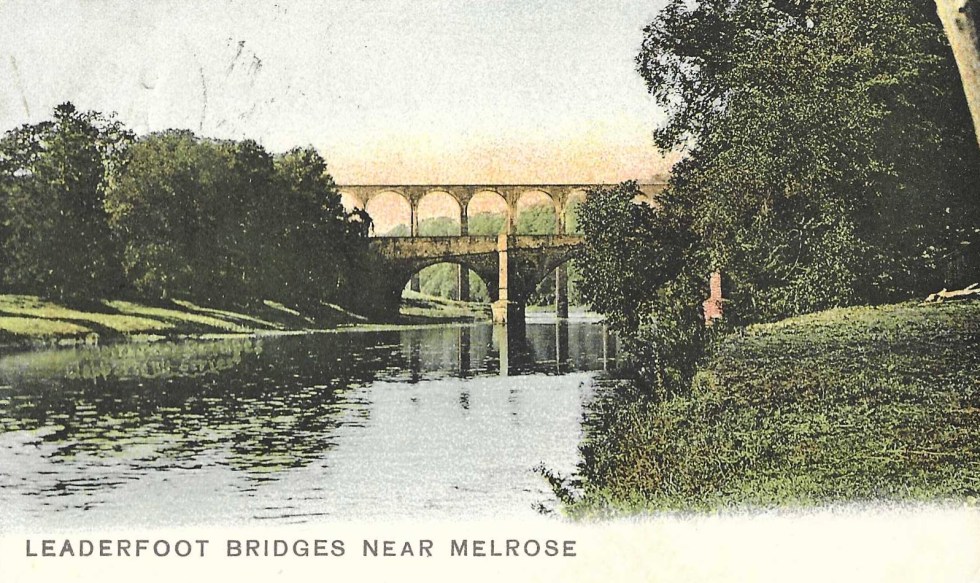
From the lodge the road leads downhill, past the arch viewpoint, until the wonderful natural scenery is interrupted by two equally attractive marvels of civic engineering – the eighteenth-century road bridge and the Leaderfoot viaduct, opened in 1863 to carry the railway over the Tweed. Both are now redundant after the closure of the railway line, and the erection of a new road bridge in the 1970s (modern visitors have to somehow erase this from their view as it could not be described as picturesque).
Thanks to Chris B for mentioning the arch and setting the Flâneuse and the Uncouth Companion the fun challenge of finding the spot. Thanks to you for reading and, as ever, your comments are very welcome. You can get in touch via the comments box at the foot of the page.