
In 1956 John Betjeman’s poem ‘Lord Barton-Bendish’ was published in The Saturday Book, an annual anthology of words and pictures edited by John Hadfield. It told the tale of the eerie mausoleum of Lord Barton-Bendish – but neither baron nor burial place was real.

In December 1955 Betjeman (1906-1984) visited the ‘very pretty village’ of Letheringsett, in Norfolk. He met up with friends who included the Reverend C.L.S. Linnell, who was both vicar and historian of the parish church, and Wilhelmine ‘Billa’ Harrod, the writer and architectural conservationist. Linnell and Harrod were working together to compile the Shell Guide to Norfolk (Betjeman was the series editor).

At nearby Letheringsett Hall lived the 3rd Baron Cozens-Hardy (1873-1956) who according to the impertinent Betjeman was ‘in his dotage’ and part of a ‘very pompous’ family. In the village church Betjeman saw the monument to Cozens-Hardy’s father, Herbert Hardy Cozens-Hardy (1838-1920), Master of the Rolls, and 1st Baron Cozens-Hardy and it captured his imagination.

Betjeman invented a mausoleum in which Lord Cozens-Hardy might have spent his eternal rest – he had spotted a hilltop copse of trees in which he thought such a structure might stand. On his way home from Norfolk, on a ‘very cold train’, he composed a poem about the imaginary tomb, which begins:
Oh Lord Cozens-Hardy!
Your mausoleum is cold;
The dry brown grass is brittle
And frozen hard the mould.
Betjeman sent the poem to Billa, with his thanks for her hospitality. His Norfolk friends soon heard about the composition and the Revd Linnell was agog, writing to Betjeman ‘Oh, please, please let me see the verse’.
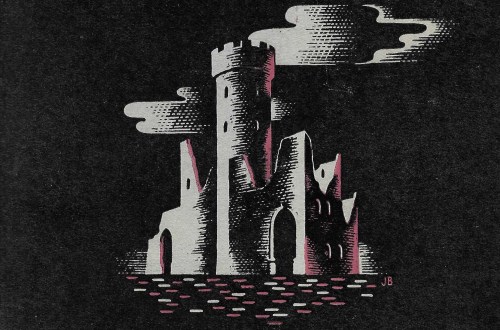
Betjeman submitted the poem to John Hadfield, editor of The Saturday Book. Hadfield liked the poem, and wanted to publish, but was understandably nervous about using the name Lord Cozens-Hardy. Betjeman consulted the vicar: was the poem libellous, would it cause grave offence to the family? The vicar’s response is not known to survive, but was presumably in the affirmative, so the poem appeared in The Saturday Book under the title ‘Lord Barton-Bendish’, with artist John Piper imagining how the mausoleum might have looked. There does not seem to be a record of why Barton Bendish was the chosen alternative: it is the name of a Norfolk village, nowhere near Letheringsett, and was presumably picked for its scansion and pleasing alliteration.

But Betjeman didn’t try very hard to disguise who the poem was about, and Letheringsett remained the setting. In what was a spectacular piece of mistiming, The Saturday Book was published in September 1956 and the 3rd Baron Cozens-Hardy died only a month later.
The poem was published under its original title of ‘Lord Cozens-Hardy’ in John Betjeman’s Collected Poems in 1958. Lord Cozens-Hardy’s family wrote to the publishers to ask that they might print a reply to refute the ‘creepy’ atmosphere of Betjeman’s poem: the poet described the ‘curious mausoleum’ as a sinister place which the villagers avoided after dark in case they encountered the ghost of Lord Barton-Bendish. Joan Silvester Horne, a member of the Cozens-Hardy family, did however exhibit a wonderful sense of humour by writing a pastiche of Betjeman’s poem. It began:
Oh my dear John Betjeman
Your poem is quite wrong…
Billa Harrod had been Betjeman’s hostess during his stay in Norfolk, and she too had advised Betjeman to change the name ‘in case of hurt feelings’. But there is a happy ending: in correspondence with the Norfolk author Peter Tolhurst, she wrote that Betjeman was later forgiven, and the Cozens-Hardys became friends.

Letheringsett Hall is now a care home, and there is no longer the ‘butler and a footman’ that Betjeman’s poem imagined serving tea on the lawn. Instead, when the Folly Flâneuse visited a few years ago (as the Covid pandemic drew to a close), the garden was occupied by the residents enjoying a rather jolly al fresco performance of Abba’s greatest hits.
Some sources claim that a copy of the poem, signed by Betjeman, can be seen on the wall of the Kings Head in the village. The Flâneuse couldn’t find it, and enquiring as to its whereabouts she was met with a shrug and a ‘John who? Never heard of him’.
The Flâneuse is indebted to W.S. Peterson’s John Betjeman: A Bibliography (2006).
Your thoughts and comments are always welcome – scroll down to get in touch. Thank you for reading.
The Flâneuse is taking a short break and will be back in two weeks.



Garance Rawinsky says:
Hurrah for Betjeman’s imaginary.
Editor says:
Good morning Garance. Imaginary landscape ornaments are just as interesting as the real thing!
Edward Mirzoeff says:
Lovely posting.
Betjeman and ‘Billa’ were very old friends; they had indeed briefly been engaged.
Editor says:
Thank you Eddie. Betjeman lived such an interesting life. I’m a big fan of Bevis Hillier’s volumes of biography.
Jane says:
So you got permission from DACS. Excellent, was it free! I said they were generally understanding.
Editor says:
Hello Jane. Thanks for your advice about DACS. Because it is a line drawing rather than a painting there was only a modest charge, which I was happy to pay so that I could tell this lovely story!
Gwyn Headley says:
Excellent — a real poem about a sham mausoleum!
Editor says:
Hello Gwyn. It was great fun working on this story!
Moira Garland says:
What fun!
Editor says:
Hello Moira. Yes, it’s such an entertaining story with a great cast of characters.
Chuckster says:
Beneath the yews, stiff-collared Hardy
Kept watch in his tomb rather tardy;
While villagers fled
From the rustle of dead—
Though the ghost only muttered, “Tea? Hardly.”🇬🇧
Editor says:
Hello Nick. Good to see poems about imaginary mausoleums are still being composed!
Chuckster says:
I wrote two actually, I think yours is the better. Sort of like saying sand in your skivvies is better than rope burn. 🪢
Barbara Howard says:
Thank you! Remembering 1960s Girl Guide camps in soggy Augusts at nearby Bayfield Park. The coach got stuck in the mud. Walks to quiet Letheringsett and in the opposite direction to Glandford Shell Museum.
Barbara
Editor says:
Good morning Barbara. Some of my favourite encounters with follies were when camping with the guides in Northumberland. I’m a huge fan of the Shell Museum at Glandford so its lovely to hear that you explored it as a girl.
Gareth Hughes says:
Letheringsett Hall has a strange, very plain, grotto-tunnel leading under the main road to a small, much overgrown, Victorian fern garden with remnants of a fountain and flint work. A rather sad, melancholy little place. I wonder if Betjeman knew of it?
Editor says:
Hello Gareth. I’m sure Betjeman was shown the tunnel, with such great local guides, but I have found no evidence.